We build AI systems for a living. We design private cloud AI environments, create custom agent workflows, and spend most of our working days helping businesses figure out where large language models actually fit inside their operations.
So you would think we would be first in line to deploy autonomous AI workers inside our own business.
We are not. Not yet.
The reason is not that the technology does not work. It is that the environment around the technology, ours included, is not ready for it.
Something Shifted
For the last couple of years, AI tools have been assistants. You ask a question. You get an answer. You prompt a model. You get a draft. The human stays in the loop and decides what to do with the output.
Autonomous AI workers are a different thing entirely.
They do not wait for a prompt. They pursue goals. They break objectives into steps, choose tools, interact with software, browse the web, send communications, and make decisions along the way. Frameworks like OpenClaw 1 and ByteDance's Agent TARS 2 , along with a growing number of agent platforms, are making this possible right now.
That is not an incremental change. It is a categorical one.
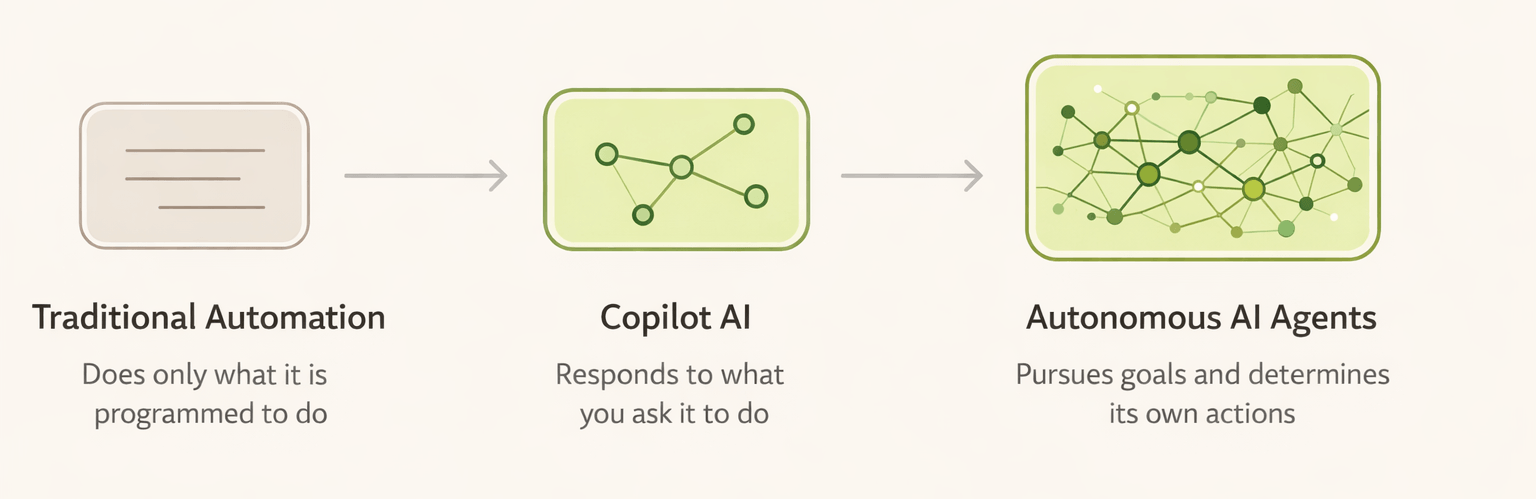
A traditional automation can only do what it was explicitly programmed to do. A copilot-style AI tool can only respond to what you ask it. An autonomous AI worker can potentially do anything a human can do with a computer.
That is the exciting part. It is also the part that should make you stop and think for a moment.
The Opportunity Is Real
We want to be clear about that. The opportunity is genuine.
Autonomous AI workers can scale knowledge work in ways that simply were not possible before. Repetitive operational tasks. Research workflows. Routine communications. Information processing. Multi-step projects that currently require hours of focused human attention, all handled without a person sitting in front of a screen.
For business owners, that means operational capacity beyond business hours. It means reducing the cognitive load on your team. It means faster execution across the kinds of workflows that quietly consume most of your week.
We believe deploying autonomous AI workers is now not just possible but inevitable for many businesses. DDSN is actively building the infrastructure to support it, for ourselves and for our clients.
But building the infrastructure is the point. You cannot skip that step.

The Risk That Is Now Impossible to Ignore
Until recently, the security conversation around autonomous agents tended to stay abstract. Alignment. Hallucination. Bias. Those are real issues, but they are not the most immediate operational risk for a business deploying autonomous agents.
The most immediate risk is access. And in the past few months, the industry has received a very public demonstration of exactly that.
OpenClaw, the open source agent framework that raced to become one of the most popular projects on GitHub, has also become the case study in what happens when capability outruns containment. In February 2026, researchers disclosed a vulnerability dubbed ClawJacked, an indirect prompt injection flaw that allowed attackers to silently exfiltrate data by abusing the agent's own autonomy. 3 Soon after, investigators uncovered a supply chain campaign in which more than 1,100 malicious skills were uploaded to the framework's community marketplace, with some becoming among the most downloaded packages on the platform. By April 2026, the project had accumulated over 255 security advisories. 3
None of this happened because the technology failed. It happened because the technology worked exactly as designed, in environments that were never designed for it.
An autonomous AI worker that operates through a screen interface, which is how many current agent frameworks are designed to work, can see everything a human user can see. It can click on anything. Read anything. Copy anything. Act on anything.
There is a second dimension that makes this sharper. An agent does not need to be malicious, or even compromised in the traditional sense, to cause harm. Through prompt injection, an agent that simply reads a webpage, an email or a document containing hidden instructions can be manipulated into taking actions its operator never intended. OWASP's 2026 analysis found that prompt injection now drives the majority of agentic AI security failures observed in production systems. 4
That is not a theoretical concern. That is how the technology functions.
The Work-From-Home Problem
At DDSN, we have spent considerable effort building a secured virtual cloud based business network. Staff connect through controlled channels. Business applications run in managed environments. We can lock things down and make sure that home computers, with all their personal software, browser extensions and varying levels of security hygiene, do not compromise the business network.
That model works well when the human is the operator. The human connects through the secure channel. The home computer is just the access device. The business environment stays contained.
Now imagine installing an autonomous agent on that same home computer.
The agent does not connect through your secure channel. It operates at the screen level. It sees what the human sees. It can interact with the secure business environment, and with everything else on that machine. Email. File system. Browser with twenty tabs open. Messaging apps.
All of the network segmentation, device trust and access controls you carefully built are effectively bypassed. Not because the agent is malicious, but because that is simply how screen level interaction works. The moment an agent operates across both, the boundary between the business environment and personal devices disappears.
That is a business problem. Not just a technology problem.
Capability Without Context
There is another dimension to this that is easy to overlook.
Autonomous AI workers are capable. Impressively capable, in many cases. But capability is not the same as judgement.
A senior team member who has worked in your business for years carries contextual understanding that goes well beyond their job description. They know which client relationships are sensitive. They know which internal processes have informal exceptions. They know when something feels wrong even if it looks technically correct.
Autonomous agents do not have that. They operate on inference. They take actions that are logically consistent with their objectives, but logic and context are not the same thing.
The result is emergent behaviour. Actions that were never explicitly programmed but that the system determines are reasonable steps toward its goal.
What Responsible Deployment Actually Looks Like
This is the part that takes time. Not because any single element is impossibly complex, but because the full picture requires deliberate design across multiple layers.
Here is what we believe needs to be in place before autonomous AI workers can be safely deployed in a commercial environment.
Contained Operating Environments
Autonomous agents should not run on open desktops. They should operate in containerised or sandboxed environments, isolated spaces where their access is limited to the specific resources they need. If an agent is compromised, or simply makes a poor decision, the blast radius stays small.
Agent Orchestration
When you run multiple autonomous agents, you need an orchestration layer that governs what each agent can and cannot do. Orchestration defines which tasks an agent may take on, which tools it may reach for, and where a human needs to approve the next step before work continues.
Identity and Access Management
Every autonomous agent needs a discrete digital identity. Not a shared account. Not the user's credentials. A distinct identity means access can be scoped to the agent's actual role, revoked instantly, and audited without any ambiguity about who, or what, performed an action.
Secured Network Architecture
Agents should operate within encrypted network environments. Zero trust access policies and segmented networks are essential, so that an agent authorised for one system cannot wander into another simply because the two happen to share a network.
Access Gateways and Cost Controls
Access gateways sit between the agent and the resources it interacts with, allowing monitoring, rate limits and full auditability. They also keep spending in check. An agent that gets stuck looping on a task can burn through API budgets remarkably quickly if nothing sits between it and the meter.
Full Observability
Every action an autonomous agent takes must be logged, monitored and reviewable. If you cannot reconstruct what an agent did and why, you cannot govern it, and you certainly cannot troubleshoot it when something goes wrong.
The Decisions That Are Not Technical
How do you represent an autonomous agent in your organisation? Do you give it a human name? Do you refer to it as a team member? Do you allow it to send emails under its own identity?
Our view is straightforward. Autonomous AI workers should not be personified. They are systems and should be clearly identified as such. Clients, staff and partners deserve to know when they are dealing with software.
Governance matters just as much. Businesses need internal frameworks that establish clear lines of accountability before deployment, not after. When an agent takes an action, someone in the organisation owns that action. Deciding who that is, and what approvals sit around high consequence tasks, is a leadership conversation rather than an IT ticket.
Weighing It Up
The Case for Moving Forward
- Significant productivity and operational scalability
- Competitive advantage for early adopters
- Reduction in repetitive cognitive work
- Capacity to operate beyond business hours
- Accelerated execution of complex multi-step workflows
The Case for Preparing First
- Security architecture is not yet mature in most organisations
- Observability tooling for autonomous agents is still emerging
- Ethical and HR frameworks are largely undefined
- Infrastructure investment is required before safe deployment
- Legal and compliance landscapes are unclear
What We Are Actually Doing
DDSN is investing in private cloud LLM hosting and designing custom AI agent workflows with built in observability, identity management and behavioural boundaries.
The goal is not to avoid autonomous AI workers. The goal is to deploy them in a way that is safe, observable and commercially responsible.
The Obvious Conclusion
Autonomous AI workers are coming. The productivity gains are real. The competitive implications are real. So are the risks, and this year has already shown what happens when deployment runs ahead of preparation.
The businesses that benefit most from this shift will not be the ones that deployed first. They will be the ones that deployed ready.
If you are weighing up where autonomous AI fits in your business, or what it would take to deploy it safely, we are always happy to have that conversation.
Frequently Asked Questions
Autonomous AI workers are AI systems that can independently pursue goals, make decisions, use tools, and interact with software without continuous human direction.
Not yet, without significant infrastructure controls such as containerised environments, identity management, network security, and full observability. Recent incidents involving popular agent frameworks have shown what happens when those controls are missing.
The most immediate risks are access and manipulation. Agents operating at the screen level can see and interact with anything visible to the user, and prompt injection can trick an agent into taking actions its operator never intended simply through content it reads.
Containerised environments, encrypted networks, identity management, observability systems, access gateways, and human approval workflows.
Businesses should establish governance frameworks that define accountability, avoid personifying AI systems, and clearly communicate how those systems operate.
DDSN is building the infrastructure required for responsible deployment, including private cloud AI hosting and custom agent workflow architecture.
References
- OpenClaw, OpenClaw open source AI agent framework, GitHub.
- ByteDance, Agent TARS, an open source multimodal AI agent stack.
- IBM X-Force, What OpenClaw Reveals About Agentic AI Security Risks, IBM Think, 2026.
- Help Net Security, Prompt Injection Still Drives Most Agentic AI Security Failures in Production, June 2026.
Expertise and Support
Working out where autonomous AI fits in your business, and what it would take to deploy it safely, is exactly the kind of problem we like to solve.
If you would like a second opinion on your readiness, or want help building the infrastructure to get there, get in touch with the DDSN team.
Contact DDSN to discuss AI integration in higher education